Marriage Biodata Format: What to Include (with Sample)
Updated · 7 min read
A marriage biodata is the first impression you make on a prospective family – often before anyone has seen your photo in person or heard your voice. A clear, well-organised biodata makes it easy for parents and relatives to say “let’s meet”.
This guide walks you through the standard Indian marriage biodata format, section by section, with a sample you can copy and specific tips for a biodata for girls and for boys.
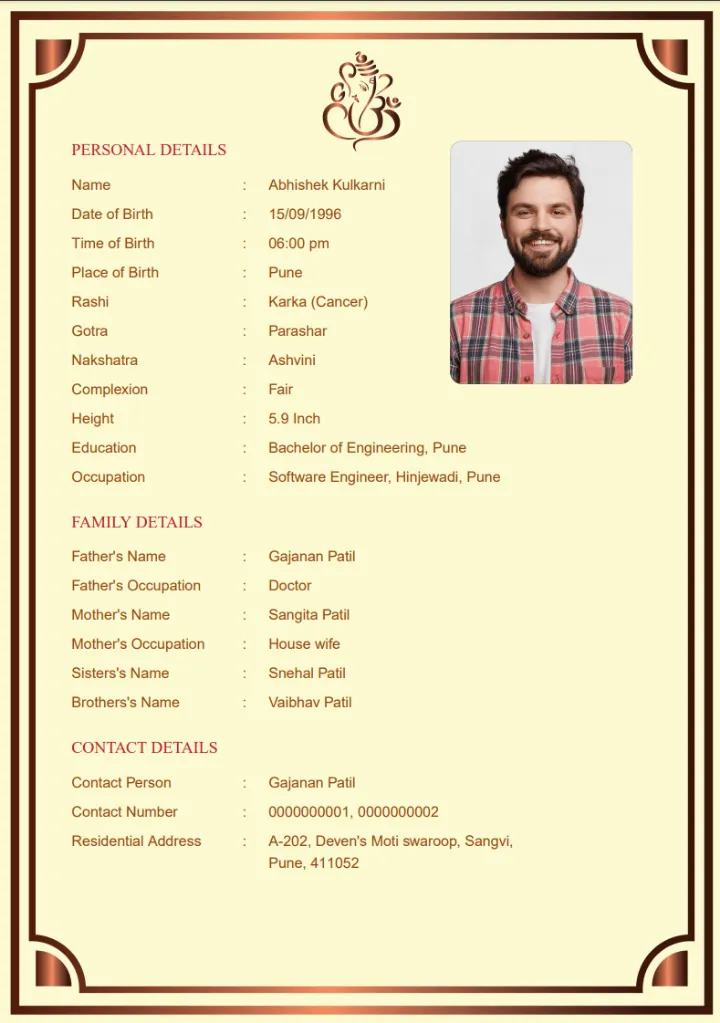
What is a marriage biodata?
A marriage biodata (also called a shaadi biodata, vivah biodata or lagna biodata) is a one-page profile used in arranged marriages in India. It is shared between families through relatives, WhatsApp groups and matrimony sites, and is usually printed on A4 paper with a photo at the top.
Unlike a resume, a biodata is not about selling your skills. It answers the questions a family naturally has: who you are, what you do, what your family is like, and – for many families – your horoscope details for kundali matching.
The standard biodata format, section by section
Most Indian families expect the sections in this order. Keeping to it means people can find what they are looking for in seconds.
| Section | What to include |
|---|---|
| Photo | One recent, clear photo – face and shoulders, plain background. |
| Personal details | Full name, date of birth, height, complexion (optional), religion, caste / sub-caste, mother tongue, marital status. |
| Horoscope details | Birth time, birth place, rashi, nakshatra, gotra, manglik status, and for Maharashtrian families devak and kul daivat. |
| Education & career | Highest qualification, college, occupation, company / business, work location, annual income (optional). |
| Family details | Father’s and mother’s name and occupation, brothers and sisters (married/unmarried), family type, native place. |
| About me & expectations | Two or three lines about your personality, interests and what you hope for in a partner. |
| Contact details | Contact person (usually a parent), phone number and city / address. |
Ready to make yours? Fill in your details and preview 50+ designs instantly.Create biodata
Sample marriage biodata
Here is how a complete biodata reads. Replace the details with your own – or enter them in our biodata maker and preview them on 50+ designs.
| Field | Example |
|---|---|
| Name | Priya Sharma |
| Date of birth | 14 March 1998 |
| Birth time & place | 6:40 AM, Pune |
| Height | 5′ 4″ |
| Rashi / Nakshatra | Mesha (Aries) / Ashwini |
| Gotra | Kashyap |
| Manglik | No |
| Education | B.E. Computer Engineering, MBA (Marketing) |
| Occupation | Product Manager, Bengaluru |
| Father | Rajesh Sharma – Retired Bank Manager |
| Mother | Sunita Sharma – Homemaker |
| Siblings | 1 younger brother (studying) |
| About me | Cheerful, family-oriented and fond of travel and cooking. |
| Contact | Rajesh Sharma (father) – 98XXXXXX10, Pune |
Biodata format for girls
A girl’s biodata follows the same format. A few things families commonly look for – and a few you can choose to leave out:
- Education and career in full – many families today give these as much weight as the boy’s.
- Whether you plan to continue working after marriage and your preferred city, if that matters to you.
- Complexion and weight are optional. Include them only if you are comfortable – your photo already says enough.
- A short, warm About me line (add it with “Add field”). See our About me examples.
Biodata format for boys
For a boy’s biodata, families usually read the career and family sections most carefully:
- Give your exact role, company and work city rather than just “Software engineer”.
- Income is often asked; you can write a range (for example “12–15 LPA”) or leave it for the conversation.
- Mention whether the family lives together (joint/nuclear) and whether you own a house, if relevant.
- Keep the tone simple and respectful – avoid long lists of hobbies.
Formatting tips that make a biodata look professional
- Use one clean font and at most two colours. Decorative designs are fine – the text must stay easy to read.
- Put labels and values in two neat columns so the page can be scanned quickly.
- Write dates as “14 March 1998” – there is no confusion between day and month.
- Add a small religious symbol (Shree Ganesh, Om, Khanda, etc.) at the top only if it is customary in your family.
- Save and send it as a PDF so it looks the same on every phone. See how to share your biodata on WhatsApp.
Common mistakes to avoid
- Old or heavily filtered photos – they create the wrong expectations.
- Spelling mistakes in names and wrong birth times – these matter for kundali matching.
- Sharing your personal phone number and full home address in large public groups. Use a parent’s number and just the city.
- Making the biodata two or three pages long.
- Sending a blurry phone photo of a printed page instead of the original PDF.
Frequently asked questions
What is the best format for a marriage biodata?
A one-page A4 biodata with a photo at the top, followed by personal details, horoscope details, education and career, family details, a short about-me line and contact details.
Should I write my income in the biodata?
It is optional. Many boys include an annual income or a range; many girls leave it out. If you are unsure, leave it for the first conversation.
Can I make my biodata in Hindi or Marathi?
Yes. BiodataMaker has Hindi and Marathi versions with all field names already translated – open the Hindi or Marathi biodata maker from the menu.